Story by The Daily Examiner.
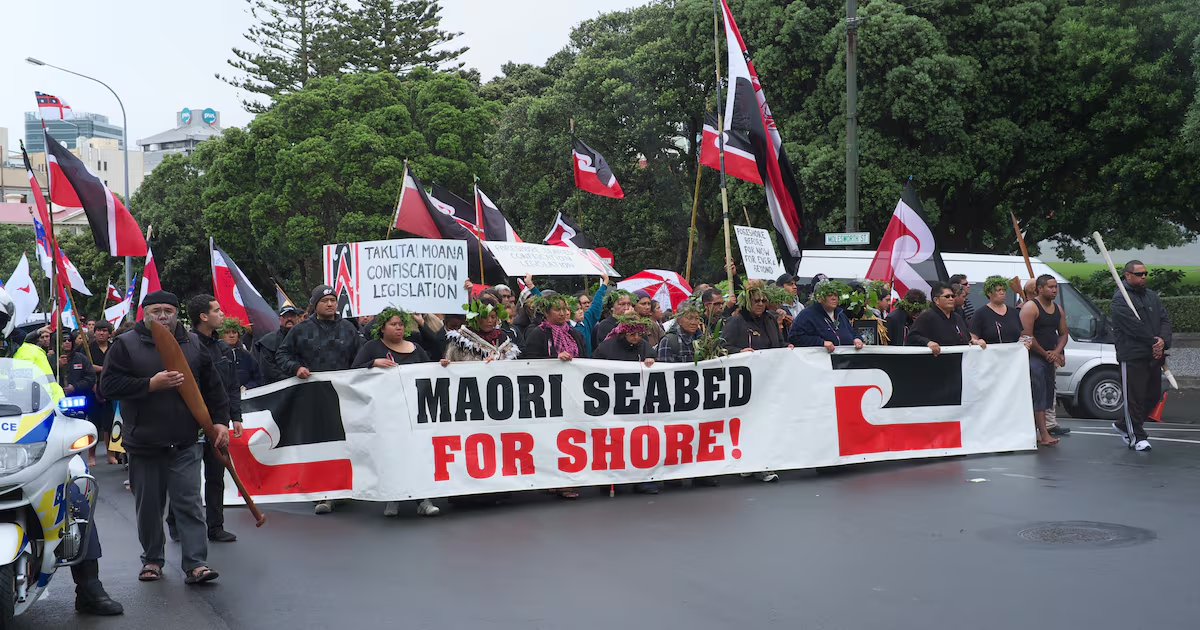
The Marine and Coastal Area (Takutai Moana) Act 2011 introduced to replace the controversial Foreshore and Seabed Act 2004, aiming to restore the ability of Māori groups to seek legal recognition of their customary rights in coastal areas.
The law established that no one owns the common marine and coastal area, but it allows iwi, hapū, and whānau to apply for recognition of Customary Marine Title (CMT) or Protected Customary Rights (PCR) under strict legal tests.
More than a decade later, the implementation of MACA has become a flashpoint in New Zealand’s political and legal landscape. According to Hobson’s Pledge, a group advocating for what it describes as equal rights for all New Zealanders, the law has led to an “absurd” situation where hundreds of claims have been lodged—some through the courts, others via direct negotiation with the Crown.
The group argues that the judiciary has taken an activist stance, granting titles too freely and undermining democratic processes.
As of early 2025, there are reportedly around 200 court applications for customary marine title and nearly 400 more seeking direct engagement with the Crown. Hobson’s Pledge contends that the government has spent over $56 million facilitating these claims, a figure they say reflects a lack of political will to reform the law.
Critics of MACA, including Hobson’s Pledge, are calling on the government—particularly Minister Paul Goldsmith—to either amend the legislation or pass a new law that, in their view, better protects public access and ensures legal clarity. They argue that decisions about the coastline should be made by Parliament, not by what they describe as “unelected judges.”
However, supporters of the Act point out that the legal thresholds for recognition are high. To obtain a CMT, applicants must prove exclusive use and occupation of the area since 1840, in accordance with tikanga (customary practices). The law also explicitly preserves public rights of access, navigation, and fishing.
The debate touches on deeper questions about how New Zealand reconciles its colonial past with its Treaty obligations. For some, MACA represents a long-overdue recognition of Māori customary rights. For others, it raises concerns about legal certainty and equal treatment under the law.
As the government considers its next steps, the challenge will be to strike a balance between honouring historical justice and maintaining a legal framework that is transparent, equitable, and widely understood.