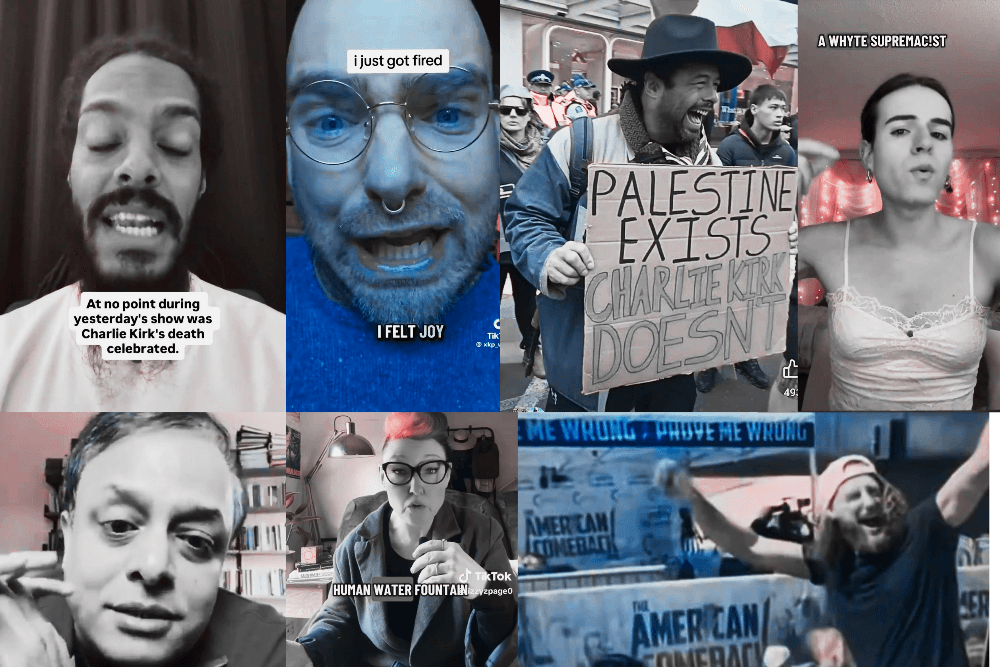
The assassination of Charlie Kirk, the 31-year-old founder of Turning Point USA, on September 10 at Utah Valley University has sent shockwaves across the globe. The suspect, 22-year-old Tyler Robinson, now faces aggravated murder charges, with evidence revealing his intent to “take out” the conservative activist.
As the world grapples with this tragedy, a wave of job terminations across Western nations—targeting those who celebrated Kirk’s death—has sparked debate.
These firings are being accepted as a confrontation of a dangerous reality: celebrating political violence can itself be part of incitement to further violence.
Celebration as Incitement: A Legal and Moral Line
Legally, incitement to violence hinges on speech or actions that directly urge imminent unlawful acts with a likelihood of producing them, as established in the U.S. by Brandenburg v. Ohio (1969), which protects speech unless it targets “imminent lawless action” and is likely to provoke it.
While celebrating a past violent act, like Kirk’s murder, is distinct from directly inciting the act itself, it can still cross into incitement territory under certain conditions. In many legal frameworks, particularly outside the U.S., glorifying violence is seen as indirectly encouraging future acts by normalizing or endorsing them.
For instance, the UK’s Terrorism Act 2006 criminalizes statements that glorify terrorism if they could reasonably inspire others to emulate those acts, even without an explicit call to immediate violence.
Similarly, international standards like the UN’s Rabat Plan of Action address advocacy of hatred that incites discrimination, hostility, or violence, potentially encompassing celebratory rhetoric that fosters a climate for further assassinations.
The European Court of Human Rights has upheld restrictions on glorifying violence when it risks public order, distinguishing it from direct incitement but recognizing its potential to indirectly fuel a violent atmosphere.
In contexts like incitement to genocide, raising past violence can contribute to ongoing incitement by legitimising it, even without a direct causal link to immediate acts.
This nuance matters.
Celebrating Kirk’s assassination—whether through jubilant tweets, memes, or public statements—can signal to others that such violence is not only acceptable but praiseworthy. In polarised times, this risks inspiring copycats or escalating tensions, particularly when amplified on platforms like Bluesky or Reddit. As Canadian scholars have argued, glorifying terrorist acts can alienate communities and provide a sense of purpose for violence, blurring the line between celebration and incitement.
Even in the U.S., where free speech protections are robust, celebratory rhetoric could meet the Brandenburg threshold if it’s directed at producing new lawless action and is likely to do so.
Real-World Consequences: Firings Send a Message
Employers across the West are acting on this principle, terminating those who crossed the line from dissent to celebrating murder. In the U.S., at least a dozen educators have been sacked or suspended for posts hailing Kirk’s death. One California high school teacher tweeted, “One less fascist – justice served,” only to be fired after her district cited the need to uphold ethical standards for students.
Conservative commentator Glenn Beck defended such moves, stating, “It’s not ‘cancel culture’ to fire teachers who celebrate Charlie Kirk’s murder.”
Beyond the U.S:
- a British Airways flight attendant in the UK was dismissed for posting on X that Kirk’s death was “poetic justice for his hate-mongering,” with the airline emphasising its zero-tolerance policy for glorifying violence
- In Canada, a university lecturer lost their job after calling the shooter a “modern-day hero” on LinkedIn
- In Australia, a Sydney marketing executive was fired for sharing memes mocking Kirk’s final moments, with her CEO noting that such actions erode client trust
These firings reflect a growing consensus: celebrating political violence isn’t just tasteless—it’s a step toward inciting more.
New Zealand examples of chilling messages
Exposed New Zealand celebratory or attempts to reduce consideration of the assassination of Charlie Kirk include the following:
Leftist academic, Mohan Dutta, Massey University communications. Just one day after Charlie Kirk was confirmed murdered, Dutta stated that “Far Right, white supremacist, extremist Charlie Kirk” held to an ideology that “shaped the Christchurch terror attack”, writing:
“Challenge the white supremacist propaganda turning the white supremacist Charlie Kirk into a martyr and a promoter of free speech.” – Dutta
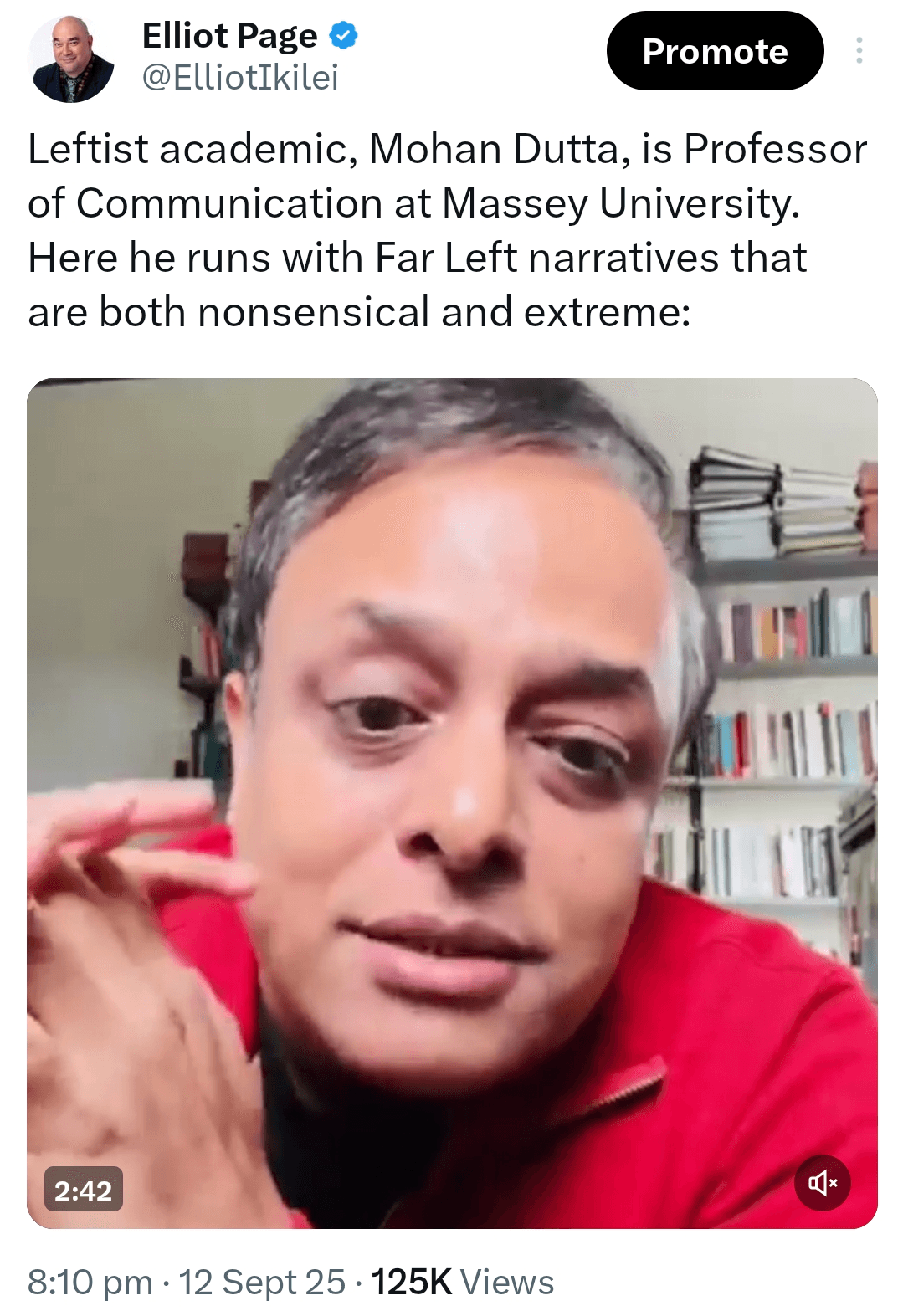
Conservative speaker Elliot Ikilei expressed grave concern about Mr Dutta’s post, saying:
It is rare to come across such a transparent communique of radical Leftism. The chilling ease that Mr Dutta seems to have in smearing Charlie Kirk’s name hours after he was slaughtered in front of his family for speaking, suggests a worrying absence of compassion, let alone holding bizarre beliefs about the young father and husband.”
Massey University, already regarded as being hostile to free speech after it was exposed for lying in order to prevent Dr Don Brash from speaking, has taken no action to correct Mr Dutta’s allegations.
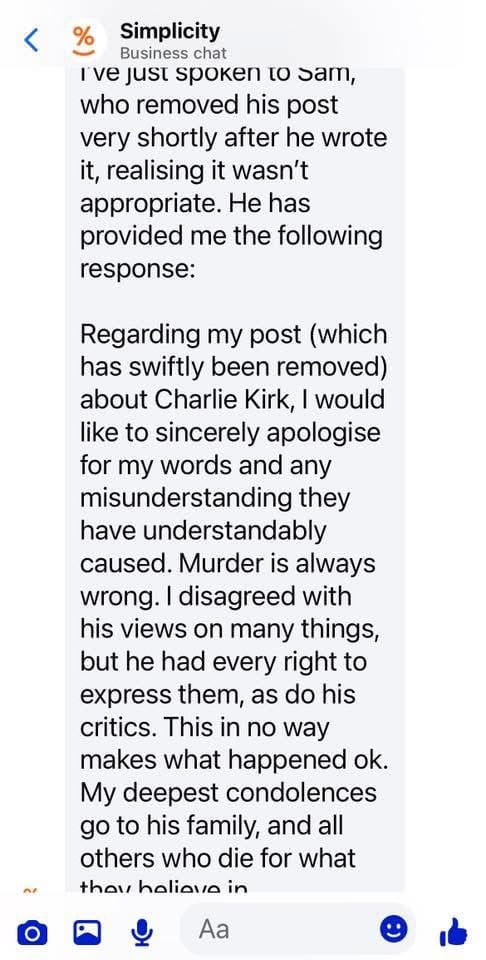
Simplicity NZ founder, Sam Stubbs, found himself facing accountability when he posted the following:
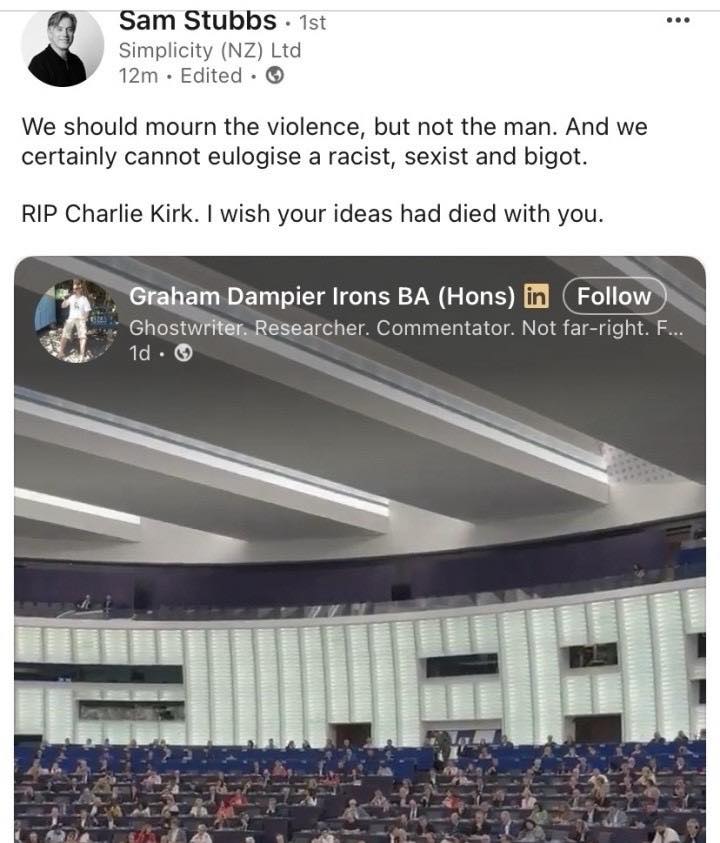
This led to a public outpouring of anguish and anger with SimplicityNZ fielding many communications.
The controversy has dredged up Stubbs’ own skeletons from 15 years ago. As managing director of Hanover Finance, Stubbs oversaw the firm’s spectacular 2008 collapse during the global financial crisis, wiping out up to $200 million in retail investors’ savings – many from everyday Kiwi families. The Financial Markets Authority (then the Securities Commission) slammed the directors, including Stubbs, for misleading statements that masked the company’s high-risk bets on property and derivatives, likening it to a “casino”.
No charges were laid against Stubbs personally, but he later admitted it was a “poor decision driven by greed”.
Eventually, Stubbs decided to take the post down and engage in damage control:
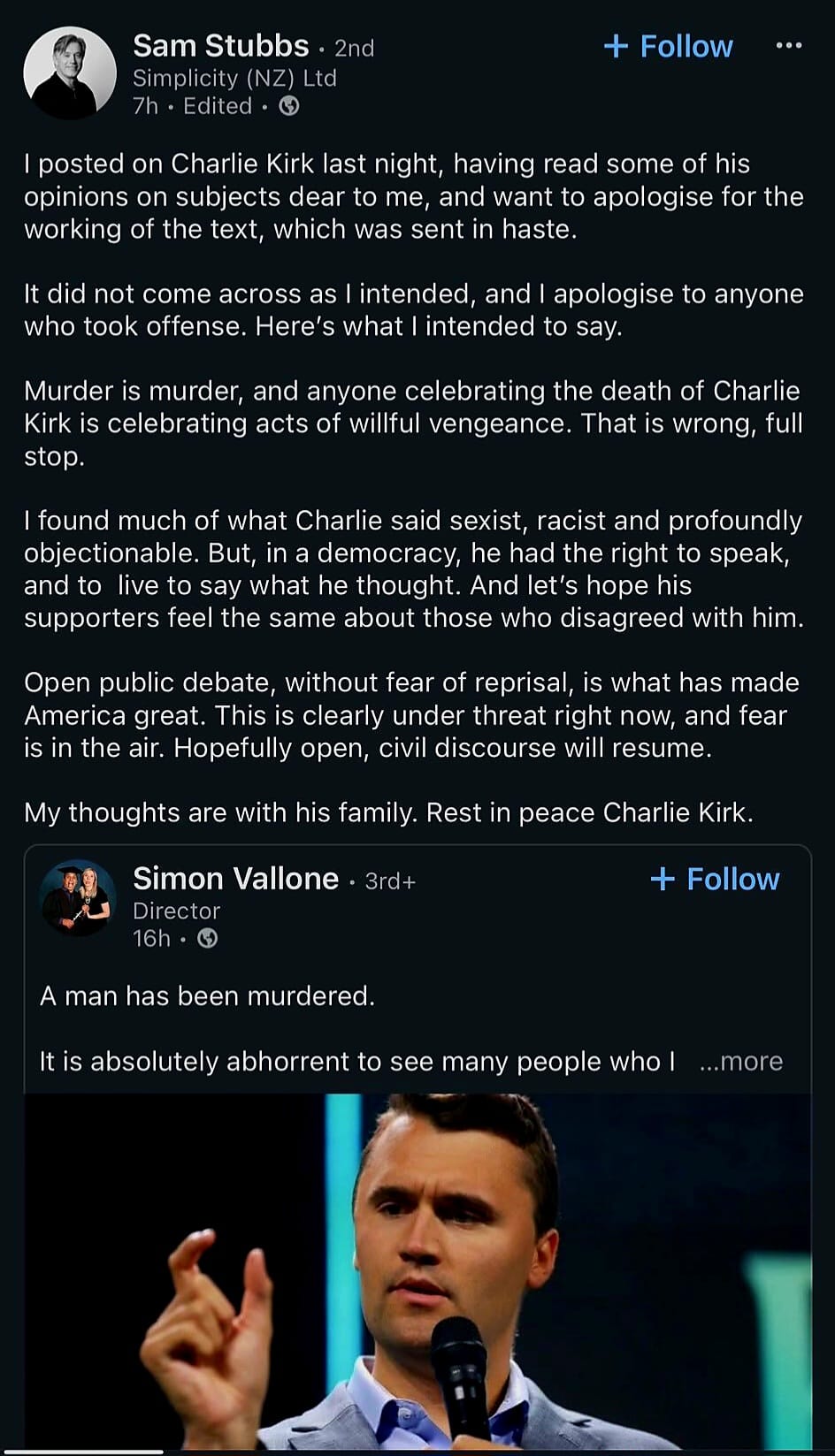
This was then passed on to Simplicity’s platforms to submit to customers and the New Zealand public.
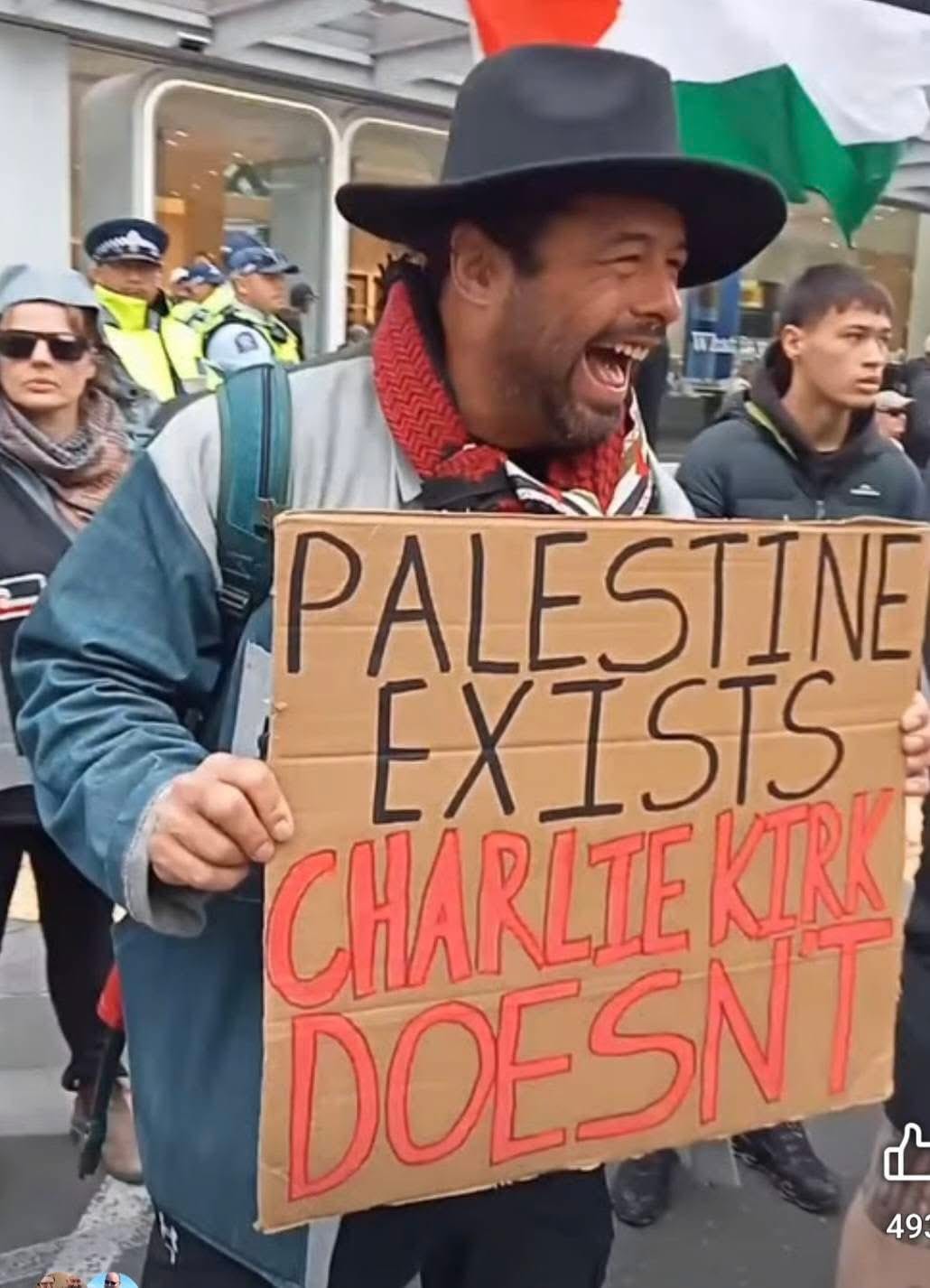
Adding fuel to the fire is Auckland activist Zane Wedding, who turned heads at a sparsely attended March for Palestine in central Auckland on September 13.
Wedding, an organiser with ties to local Palestinian solidarity groups, hoisted a handmade sign reading: “Palestine Exists, Charlie Kirk Doesn’t”.
The placard, a pointed jab at Kirk’s past dismissal of Palestinian statehood during a 2024 debate – where he quipped “Palestine doesn’t exist, it’s Judea and Samaria” – was photographed and shared widely online.
The General Manager of Mangere Mountain Education Centre is funded by taxpayers and ratepayers.

A Necessary Stand for Civil Society
The job losses sweeping Western nations are not being seen as punishing thought but about protecting society from a cycle of violence.
As JD Vance, U.S. Vice Presidential candidate, said, “There is no civility in the celebration of political assassination.
New Zealand employers and policymakers should take heed. While our Human Rights Act protects expression, it doesn’t shield endorsements of murder that risk inciting further violence.
Kirk’s killing, alongside recent U.S. political violence like the 2024 attempts on Trump, underscores the stakes.
Many now view the terminations not as reacting to a tragedy — rather an attempt to prevent the next one.